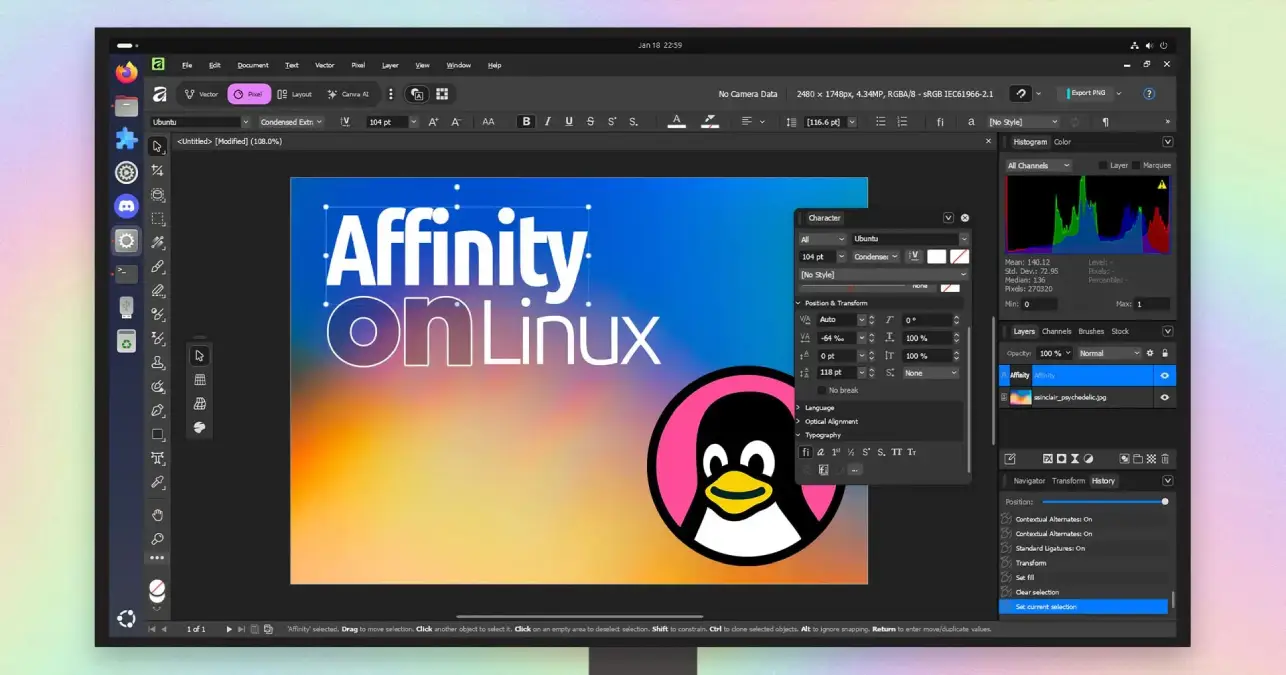
For years now the “Linux year of the desktop” has been more or less of a running joke in the tech community, since at least the bet that The Well Washedavigation does, for creative professionals, as there is a shortage of native software. If you are a digital artist, you vector geek or if you are a desktop publisher then chances are that you have felt the sting of being left out by the big guys. Adobe has made it infamous hold its Creative Cloud strapped to the rear of Windows and MacOS, leaving Linux customers to get used to the learning curves of GIMP, Inkscape or Krita. While those open drain (or, er, powerhouses) are incredible the industry speak, of Affinity or Adobe. However, the tide is beginning to turn in 2026 and the bridge between Windows apps of professional-grade is better than ever before, and the Linux ecosystem freestanding. The latest break comes in the form of a streamline version of AppImage that inspired one service whose job it is to make running the Affinity v3 suite on Ubuntu – and its various cousins of Ubuntu Linux like Linux Mint and ZorinOS the pretty scary simple.
Read also:Your Eyes Are Lying To You And This Viral Web Game Proves It
The creative software’s landscape changed very soon when Canva purchased Affinity in 2024 – the subsequent “revamped” variant, calling it a “freemium” format after rolling it during a semester of 2024. Today, the Affinity suite – made up of Photo, Designer and Publisher – is a combined powerful application. While it is still considered a native staple for users of both Windows and macOS platforms, the Affinity team has made it a point tease the possibility of an official version for Linux, telling us that they are taking the requests of the community seriously – this time. But as has been the case for anyone who has been a user of Linux, one can’t wait on an “official” release because that can take forever. Thankfully, there is no interest in the community to wait. The Linux Affinity Installer project has come to the rescue to offer a solution to fill the gap and a means to run the Windows instrument of this creative powerhouse on Linux using the magic of Wine the famous Co-Existence of Windows Windows compatibility layer. This community driven effort is a work of art by developers that are not ready to live their life[s] in respect to their productivity.
Read also:Why Your Windows Task Manager Is Secretly Tricking You Every Day
Navigating the world of Wine is anyhow may see kind of like going through some astrology of a digital, with and convoluted configurations, missing dependencies, and endless terminal troubles. The Linux Affinity Installer project established a way to install it in a standard way by depending on your system’s local version of wine and a lot of manual tampering. However, this was a problem for many more so for those who were based on Ubuntu style distributions. As Ubuntu development often reflect the stability rather than “bleeding-edge” packages their repositories have not always the specific dependencies of a given content which are updated for the following Affinity experience to run smoothly. This caused the project to put Ubuntu in “unsupported” for the standard installation script. But don’t let that tag put you off as the alternative is much better all things being equal, the average user. The project is now providing a standalone AppImage which provides a “portable” container housing all that the software requires to run in however single file.
Read also:Your Raspberry Pi Is Getting The One Upgrade You Have Been Waiting For
Using the AppImage on a current version of the OS such as Ubuntu 24.04 LTS is a breath of fresh air. It side significance embedding a naseous system-wide dependency hell with a pre-configured version Wine 10.x on board with all the required libraries with tweaks. In seven days on the road with small-scale testing however, on even a modest hardware – like the low power Chuwi laptop – the results are pretty usable surprisingly so. For the raster graphics mill (medium refers to “Pixel”) the tools are dead fast and responsive. Whether you are adjusting levels, applying filters or going through complex menus, experiences are similar to the type of experiences you would have been used to of a native Windows machine. All the standard dialogs, options and effects work as expected, to spent your time getting some real design work done and not battling with the operating systems every step of the way.

Read also:AYANEO Pocket DS Secretly Taking Screenshots and Using Massive Data? The Truth Revealed
Performance obviously isn’t just magic. You start to feel your hardware – and the level of compatibility – working overtime when you start pushing the boundaries at opening huge files in Photoshop (.PSD) containing dozens of layers, smart objects and nested mask groups. The lower end machines, the things can certainly crawl when doing some heavy processing. It is important to keep in mind that the AppImage uses the DXVK as a graphics acceleration facility, which is a conversion of Direct3D calls into Vulkan calls. This reps UI as a render UI so smooth to a majority that are on Intel integrated graphics. However, there is a catch as far as OpenCL support is concerned. The AppImage on this moment does not contain integration of OpenCL which means that anything that is a heavy duty filter and effect, which would normally take the raw power of your GPU to complete, they have to do them with your CPU. For those on a Intel iGPU this could actually be a blessing in disguise for it is widely known that OpenCL is notoriously buggy for those chips. If you are an Nvidia user that really needs OpenCL for some fancy rendering illumination, you may yet have to onlook up the more complicated procedure of by hand installing it.
Read also:This Legend of Japanese Horror is Finally Returning to Haunt Your Nightmares
Beyond the technical merits to this workaround there are however a couple of “quality of life” peculiarities to consider when using this. Since this is a Windows version in a container, some Web-Integrated features have difficulties. For example, part of the site is not currently working (sign in to a canva account), part of the site will get stuck in a loop (do sign out) – and features that use the webview2 feature, such as the in-built help system or the welcome screen you’re presented with to download from the webview2 will not show. But, to most designers, these are just bumps along the road, when compared to the opportunity for having the professional vector and photo editing tools on the Linux desktop. The tradeoff is simple, you lose a little bit of disk-space – the AppImage only look like about 1.2GB, and you have another 3GB of files generated the first time you pack and unfold it – but you save hours of time that you would have spent wrestling with some configuration files.
Getting started is as easy as downloading the file from the GitHub releases page for web project that you downloaded the GitHub page link from. It’s just that once you’ve downloaded the file you just give it the mark of executable and run it. On your first launching, there is a handy DPI slider which lets you scale the user interface so that on your particular monitor resolution, it looks as good it gets. Were ever you compelled to get any deeper into the guts of the giant setup you can even jump up into the Wine settings by applying the AppImage through your terminal with a particular command. This kind of accessibility has made this project a game changer to the people who use it casually or even professionally. Whilst it is a volunteer led effort and “perfection” isn’t guaranteed, the active community on PokemonGo as a group on Discord and the GitHub is in place the help is never far away if you do run into a snag. It is emboldened new manner for the creativity of Linux yet perception simply by this AppImage, the wall separating Ubuntu yet industry common place design instruments has finally began to parasites.
Disclaimer: The information provided in this article has been collected from publicly available sources on the Internet. Readers are requested to verify this information with available sources.