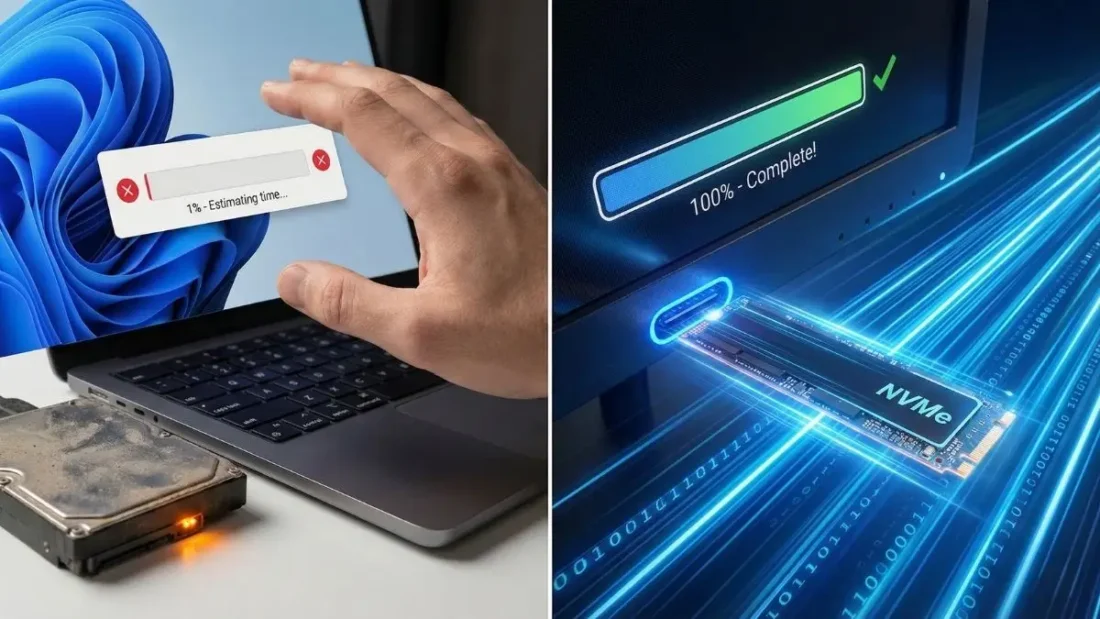
We have all been there. You are transferring some huge photo folder or a 4K video that weighs like a rock and the Windows 11 progress bar does not seem to move at all, as it is reflecting on the meaning of life. It begins well, begins with a good speed and then abruptly breaks on a crawl that brings back memories of the dial-up internet era. It is so annoying, that even when you are aware that your hardware is capable of more than it can do. The fact is that file transfer in Windows 11 is not a set and forget some case. It is affected by an untidy tangle of hardware restraints, software supports and even the manner in which you transport your data. When your PC is slowing down, you are not dreaming but you need not put up with it. With a few strategically setting your workflow, as well as settings, you can reduce those wait times drastically.
The physical media is the most important in determining the rate at which your files can be accessed. When you are still using the old-fashioned mechanical hard disk drive (HDD) with rotating platters, you will be attempting to race a marathon race inside a food additive molasses tank. The most effective change is the upgrading to solid state drive (SSD). The data also is operated by SSDs with flash memory that is light-years faster compared to the real movement of an HDD. In order to gain actual experience of the needle actually moving, you might consider NVMe drives, then simply plug them into your motherboard slot in the PCIe. These drives can thrust data more rapidly than normal SATA SSDs can. With just a drive upgrade to the one that you are copying off of, you will find an enormous difference in latency and a considerably more reliable transfer rate.
The speed of a hardware does not count when you are stuffing your high tech external drive to an open can. Not all USB ports of the Windows 11 machine are created equally, and many users are not aware of this fact. When you connect an external SSD with a high speed to an older USB 2.0 port, operators usually the ones with the interior made of black plastic, you are limiting your speeds to a fraction of the actual capability of the drive. Where possible, the blue-colored ports or S appearing ports are always associated with SuperSpeed. These are 3.0, 3.1 or 3.2 USB ports which have the bandwidth required when it comes to modern data needs. It may seem a minor detail, but it can take you literally twice or even thrice as long to transfer something when you are using the incorrect hole on the side of your laptop.
Although we are discussing drives, their formatting has a significant impact on communication with the Windows 11. Most thumb drives are contaminated as FAT32 (older) protected but NTFS is significantly more efficient with Windows. NTFS is highly application-specific to the Windows environment, and provides superior caching and significantly superior file manipulations to huge assets. When transferring large files where the transfer starts stuttering or halting, it is possible to change the destination drive to NTFS which offers the stability and the overhead necessary to ensure the data keeps going where it needs to and without hiccups.
The hard tool you are working with sometimes is the problem not the hardware. We all enjoy the ease of drag and drop in file explorer but with a large file of transfers over several gigabytes to make file explorer is in fact very ineffective. It works in a linear fashion on files one at a time. You can, however, attempt to use Robocopy, which is a strong command-line utility that is literally embedded within windows. Contrary to the normal method of copy-pasting, Robocopy has the multithreading feature and as such, one can move several files at once. It is also much more robust, in case a transfer is interrupted due to a topical network mule or a cable tremble, Robocopy can continue where it stopped and you do not have to watch the whole procedure begin all over once again.
In another covert way of causing speed, your antivirus program is the other speed killer. I do not mean to imply that you should not use real-time protection to ensure that your system is safe. Your security suite is insisting, however, to scan each bit of data on its way between point A and point B. In the cases of transferring thousands of small files, the antivirus must open and scan every file and this provides an enormous processing overhead to the transfer. You can temporarily suspend your real-time protection to provide a large performance boost to the transfer of data that you know is secure, such as your personal backups or media files. All you need to do is to switch it off and on as soon as the progress bar reaches 100% of its length.
When you have to move a folder that contains thousands of small files or pictures, what you may find is that it will take quite a long time to do so, compared to when you are moving a single huge movie file. The reason is that windows is supposed to generate a distinct file system entry which is part of an individual file. To avoid this headache, you just have to compress the folder into one compressed file and then transfer it. Converting ten thousand little files into a big ZIP file saves the administrator the work Windows has to perform when completing the transfer, which in most cases shortens the total amount of time to a much lower number.
Lastly, monitor what is going on in your PC. Windows 11 does a solid multitask, but does not have a lot of power. With a browser open with about 40 tabs, a video editing software that has nothing to edit or a game-launcher to update its collection of updates, all the above are competing with your available storage and memory.
One last thing to consider when sending a large file is to close earlier apps that you are not currently using before you give the file the send button. Clicking on the lane button allows windows to prioritize the move and your files will get to their destination quick.Quick transfers do not involve buying the latest high priced PC, it is what you already possess by choosing the tools and settings that are already available and making good use of it.
Here is how to use it like a pro.
Step 1: Open the Command Line
To get the most out of Robocopy, you should run it with administrative privileges to ensure it doesn’t get hung up on system permissions.
-
Press the Windows Key and type cmd or Terminal.
-
Right-click the result and select Run as Administrator.
Step 2: Understand the Basic Syntax
Robocopy follows a very logical “From-To-How” structure. Before you type anything, visualize the command like this:
robocopy [Source] [Destination] [Options]
Step 3: Use the “Turbo” Command
For a standard high-speed transfer where you want to move everything from one folder to another, use this template. Copy and paste it into your notepad first to swap out the folder paths:
robocopy "C:\YourSourceFolder" "D:\YourDestinationFolder" /E /MT:16 /R:3 /W:5
Breaking Down the Magic Flags:
| Flag | What it Does | Why it Speeds Things Up |
/E |
Copies subdirectories, including empty ones. | Ensures your entire folder structure is mirrored exactly. |
/MT:16 |
Multithreading (The secret sauce). | Instead of moving 1 file at a time, it moves 16 simultaneously. You can go up to 128, but 16-32 is the sweet spot for most PCs. |
/R:3 |
Retries. | If a file is in use, it will only try 3 times instead of the default 1 million times (which hangs the process). |
/W:5 |
Wait time. | Tells the system to wait only 5 seconds between retries, keeping the momentum going. |
/Z |
Restart mode. | If your network or drive disconnects, it can pick up right where it left off. |
Pro-Tip: The “Mirror” Command
If you want the destination folder to be an exact copy of the source (meaning it will delete files in the destination that no longer exist in the source), use the /MIR flag.
⚠️ Warning: Be careful with
/MIR. If you point it at the wrong folder, it will delete files in the destination to match the source!
How to Copy Paths Easily
Instead of typing out long, annoying folder paths like C:\Users\Name\Documents\Backups\2024, you can:
-
Type
robocopyfollowed by a space. -
Drag the source folder from File Explorer directly into the Command Prompt window. It will paste the path for you.
-
Drag the destination folder in next.
-
Type your flags (like
/E /MT:32) and hit Enter.
Disclaimer: The information provided in this article has been collected from publicly available sources on the Internet. Readers are requested to verify this information with available sources.