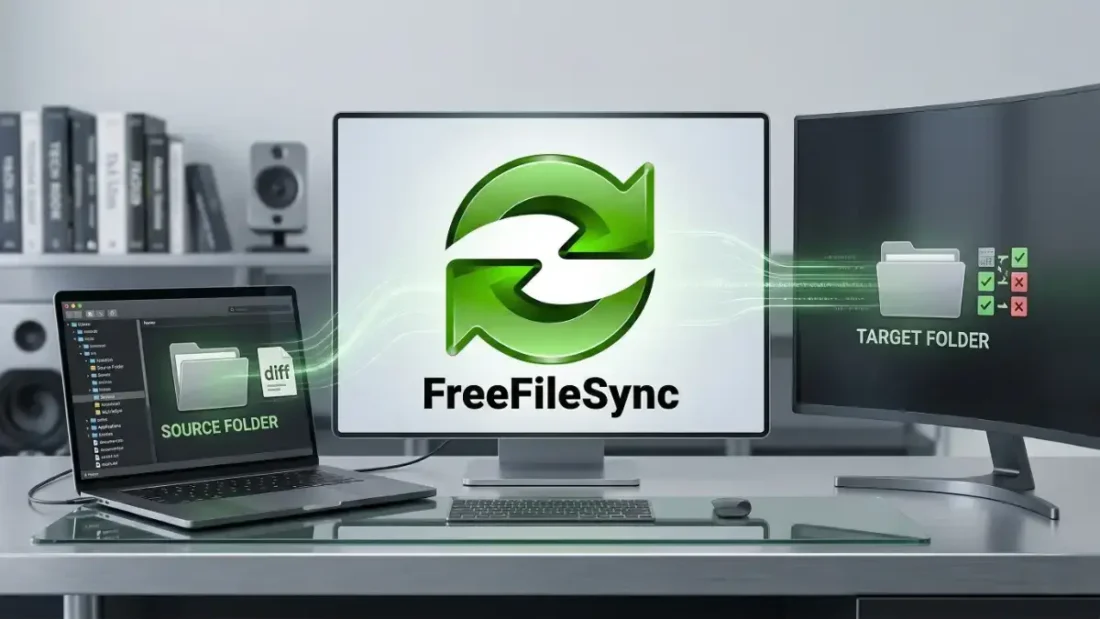
In an era of exponentially growing data volumes, the old fashioned approach of managing backups through the “copy and paste” approach has become a disastrous waste of both time and hardware resources. For professionals with terabytes of creative assets, developers with complex local environments or power users trying to secure their personal archives, it is rarely the capacity of storage that is the bottleneck, but rather the inefficiency associated with the data transfer process. FreeFileSync solves this most rudimentary friction and begat a sophisticated comparison engine that is aimed at making the exact delta between two storage states. By only having to match the data contents to the floor, the software takes what could be a hours long process and finishes it in seconds, which greatly helps in the I/O taxation of both mechanical and solid state drives.

The technical genius of FreefileSync is its granularity when it comes to file system analysis that goes beyond the basic file timestamp checks used by generic sync utis. While many tools are based on using only “last modified” dates, easily spoofed or inaccurately flagged by OS-related background processes, FreeFileSync has an option of a bit-by-bit binary comparison mode. This helps ensure absolute data integrity to validate the actual content of the files instead of using metadata which may be different across different file systems (see an NTFS, APFS, or EXT4 for example). For users operating in cross-platform environments, this kind of inspection is indispensable because it saves the interception of data loss that can be caused by plainly by transferring from a system to another when these systems have different performances towards symbolic hyperlinks, hard hyperlinks and prolonged attributes.
Also read:Microsoft Refines Windows 11 With Long-Awaited UI Fixes
Beyond easy file movement, the software makes use of a very optimized “Two-Way”, “Mirror” and “Update” logic where users can define how exactly conflicts should be resolved. The “Mirror” mode is of special interest in the field of disaster recovery, since it creates an exact 1:1 copy of the source, effectively chopping out deleted files from the target in order to ensure their backup is never littered up with old versions. Conversely, a local database to keep track of the file ID and movements is used in the “Two-Way” synchronization, this will enable the software to differentiate between a “deleted” file and a “simple” file that has just been moved or renamed. Without this tracking database, a directory moved file would usually be considered as if it were a deletion, followed by a newly uploaded file, which would take unnecessary bandwidth and write cycles-which is critical for someone syncing to cloud targets from SFTP or Google Drive.
Also read:Why This New WebKit Browser is the Holy Grail for Power Users and Privacy Seekers
Automation is another area where FreeFileSync has shown its ability to play on the senior level and that’s its tool for that, RealTimeSync. Rather than the time-sensitive code performing the solutions manually, the RealTimeSync is a way to treat the time-sensitive directory as a listener that is notified by the operating system when a file is changed. When some change is detected – such as a photographer saving a new RAW edit or a programmer making a new local code change – the utility is able to trigger a pre-defined batch job to sync the data instantly. This makes for a “set and forget” workflow that is competitive with costly enterprise-level backup solutions, all the while keeping it completely within the control of the user. The fact that these configurations can be exported as separate batch files allows them to also go into Windows Task Scheduler or Linux Cron jobs, which allow for a degree of flexibility, not to say availability, that is often locked behind a subscription wall in proprietary software.
Also read:AYANEO Pocket DS Secretly Taking Screenshots and Using Massive Data? The Truth Revealed
From the architectural point of view, the freedom of operations is supported by a native C++ backend of FreeFileSync. Unlike too many other modern utilities based on resource-heavy build frameworks such as Electron, FreeFileSync has highest memory footprint while providing quickly executed performance. This performance is especially apparent during the comparison phase of big directories that have hundreds of thousands of files, the software can traverse through complicated tree structures with incredible speed, and opens a visual grid of proposed changes before a single byte is actually moved. This “preview first” philosophy is an important protection for technical users that provides a manual way to server a potential sync conflict before it causes data loss, and a layer of transparency for command line tools like rsync that those who feel comfortable with a GUI-driven workflow do not have.
Also read:Your Eyes Are Lying To You And This Viral Web Game Proves It
Finally, the everlasting understanding of FreeFileSync is related to how it is available as open source software. In this day of “Software as a Service” marketmodels, which are based on keeping user data hostage behind recurring charges, a transparent, community-vetted tool is something for which, when it comes to backup infrastructure, trust is of the utmost importance. Its Cross platform parity between Windows, macOS, Linux would ensure that as a user’s hardware ecosystem evolves, his synchronization logic will not be disrupted. By combining deep technical features such as NTFS security permission copying and VSS (Volume Shadow Copy) support (which enable the possibility of backuping files even while they are being processed by other applications), FreeFileSync offers a robust set of features that can meet the rigorous requirements of system administrators while still needing a level of accessibility suitable for a general consumer trying to increase the robustness of their data redundancy strategy.
Disclaimer: The information provided in this article has been collected from publicly available sources on the Internet. Readers are requested to verify this information with available sources.